
Unpacking FlexHealth
A week ago I spoke about broken windows and how I'd been working on fixing some of mine... I showed two years of my blood work going from red to green and mentioned that I had done the Warren thing and built an "entire unified health platform to track it" and that I would unpack it soon. Well... soon has arrived. lol.
Why it exists at all
The short version is that in 2024 my blood work was a full dashboard of blinking red warning lights. If you want the long version you can read the full post here. I had previously used Co-pilot to chat about my health markers, workouts and my eating patterns... but it started getting "confused" as the conversation got longer and more complicated. I figured if I had all the data in a database that I could feed to an LLM, put on graphs and monitor progress, I could see where I was going and the impact of the changes I was making.
The platforms I found that could do this either needed specific hardware or integrations into laboratory APIs. Many are also "always connected" and here in South Africa our relationship status with both electricity and connectivity would be listed as "it's complicated". Some captured health markers, some captured workouts, some captured steps.
My training lived on one app, my food/nutrition tracking lived in another, my bloodwork lived in PDFs I pulled from the lab. There wasn't somewhere or somehow to easily join them up (besides trying to have a long convoluted conversation with Co-pilot).
I hit it Warren Style as always... and built the thing I needed.
What it actually is
FlexHealth is a web and Android app. I've been using them to track all of my data. I'm patient zero and my own markers were the requirements document.
What it tracks:
- Blood tests, from any lab. You type in the results off the printed sheet from any provider with no integration needed. Out-of-range markers get flagged and explained in plain language, and every marker gets a trend line across all your tests. This is the feature that produced the charts you saw last week.
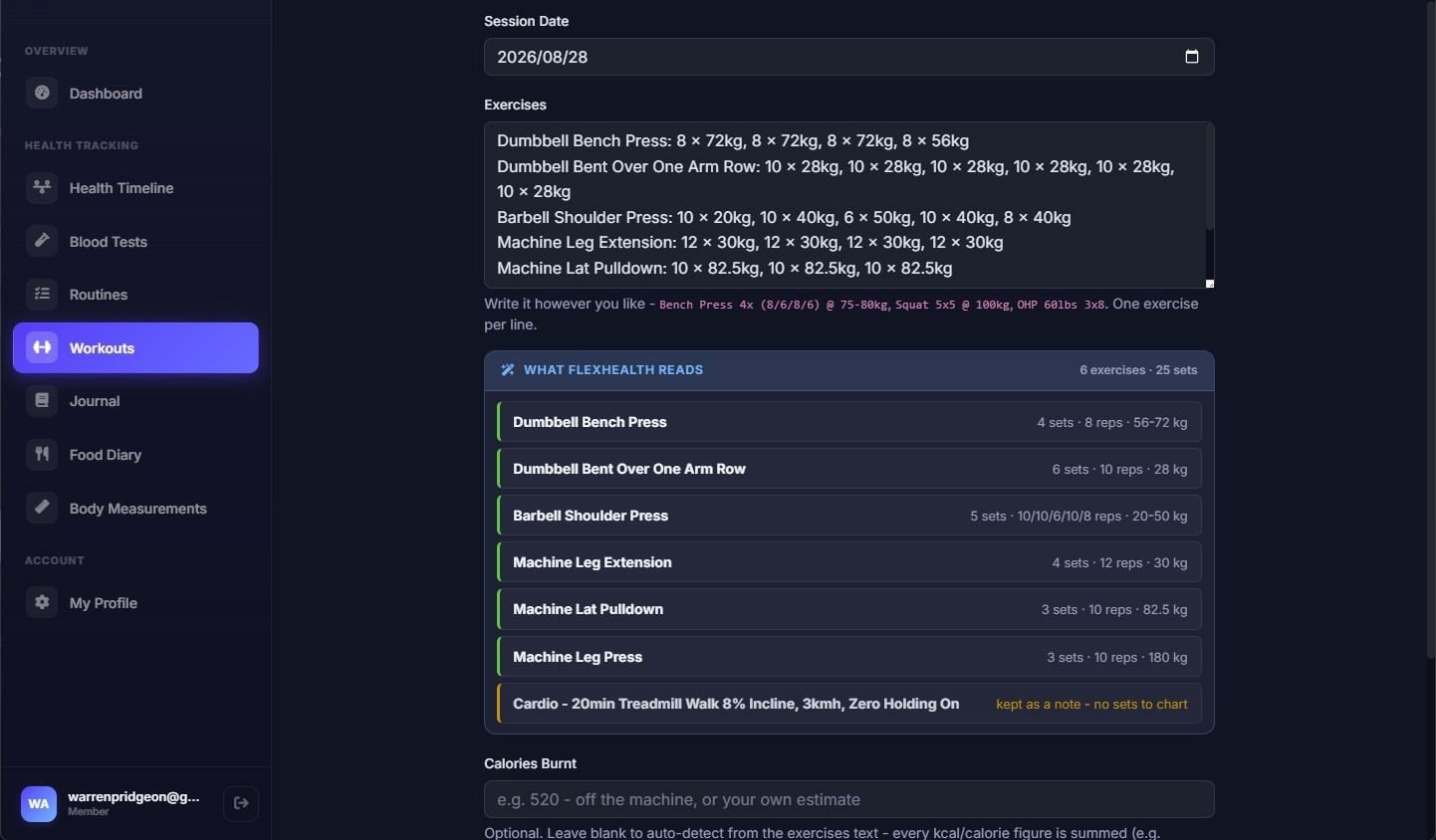
- Workouts, in your own words. This is my favourite party trick, you don't have to select from dropdowns... You type
Barbell Bench Press 80kg x 8, 85kg x 8, 85kg x 8, 60kg x 12the way you'd text a buddy, and it turns that into structured sets, reps and loads, charted per exercise across everything you've ever logged. No tapping through forms between sets with shaking arms. - Food. Meals, calories, macros, daily targets, weekly trends. (This is where the 210-day logging streak lives. I packed a food scale for a family trip. I'm aware of what I've become.)
- Body measurements. Weight, body fat, and thirteen tape-measure sites, charted over months so that slow change becomes visible. Slow change is the only kind that's real.
- A daily journal. This one sounds like a "dear diary, today she sat next to me on the bus"... but it's far far more. Capture how you felt during the workouts you did, any injuries you have, life events etc etc.
Here's the party trick in action. That's my actual session from last Friday, typed the way I'd text it, and what FlexHealth read out of it (including keeping the treadmill walk as a note because there's nothing to chart about battling an 8% incline on a treadmill):
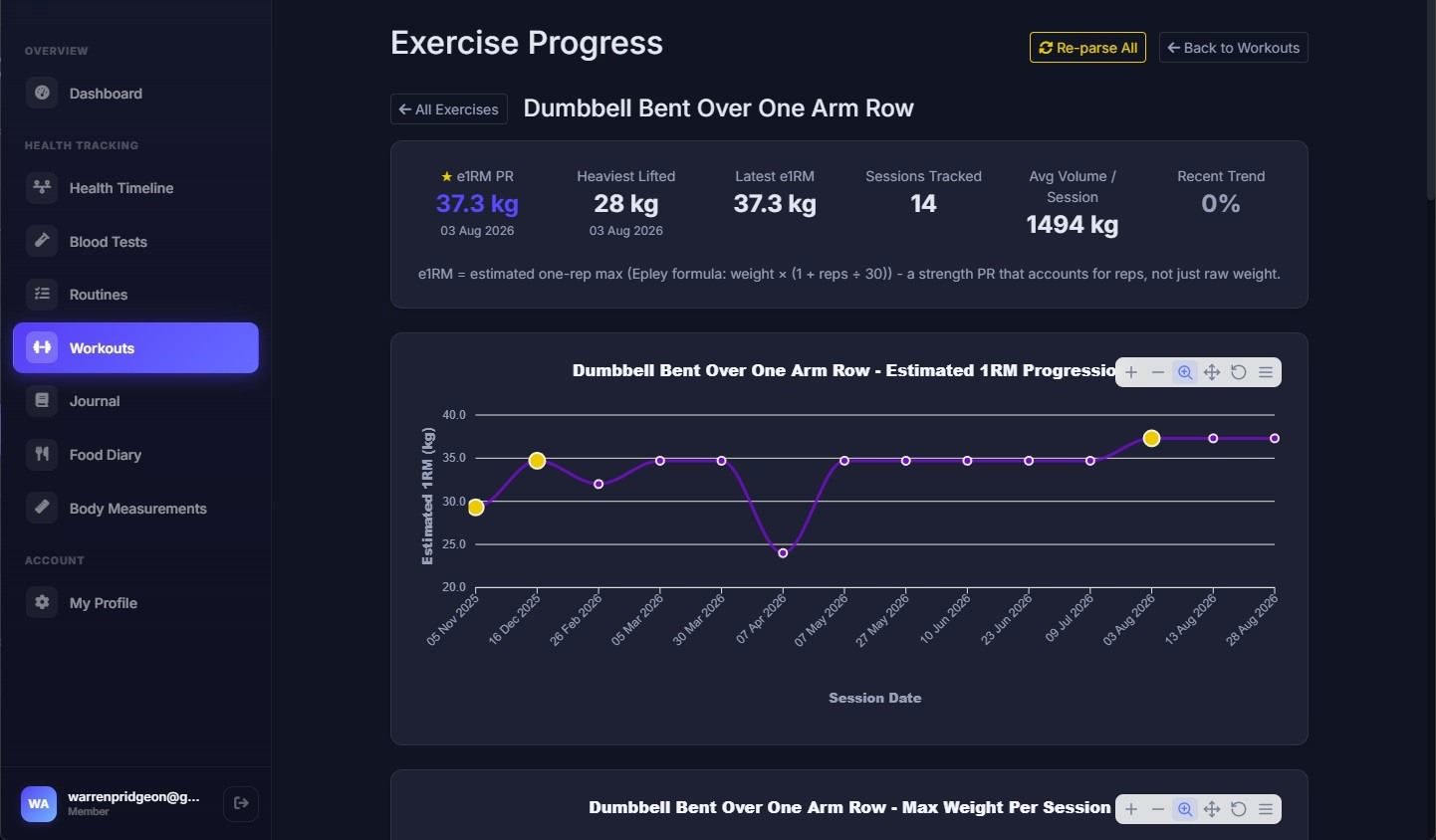
And because every set feeds the charts, you get progression per exercise across everything you've ever logged:
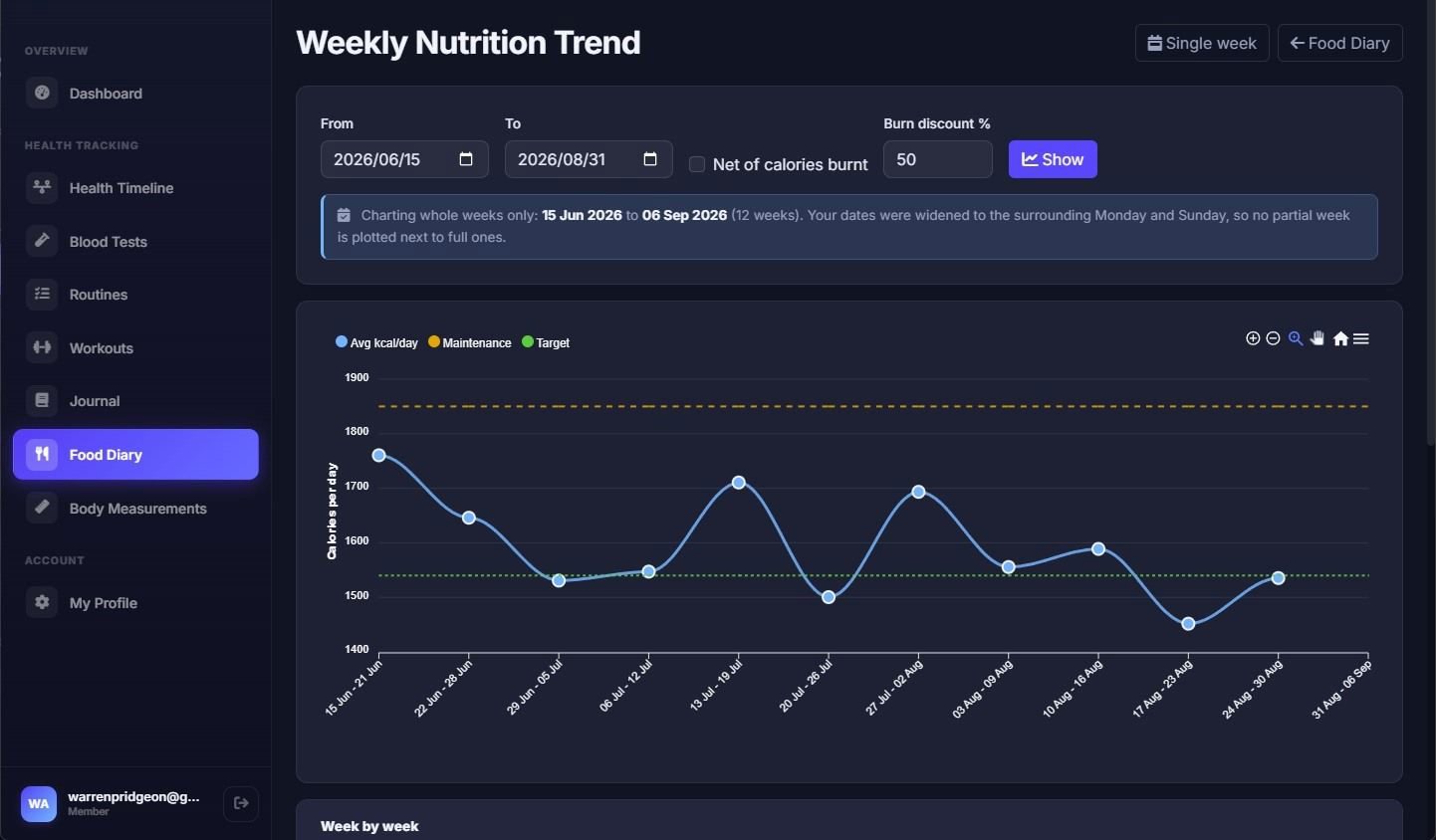
The food side gets the same treatment, weekly calorie trends against my maintenance and target lines:
The part no other tracker does
All of the individual things I've mentioned exist in other places and platforms. The reason I built FlexHealth is what happens when you join them into a unified health view, which I call the Unified Health Timeline.
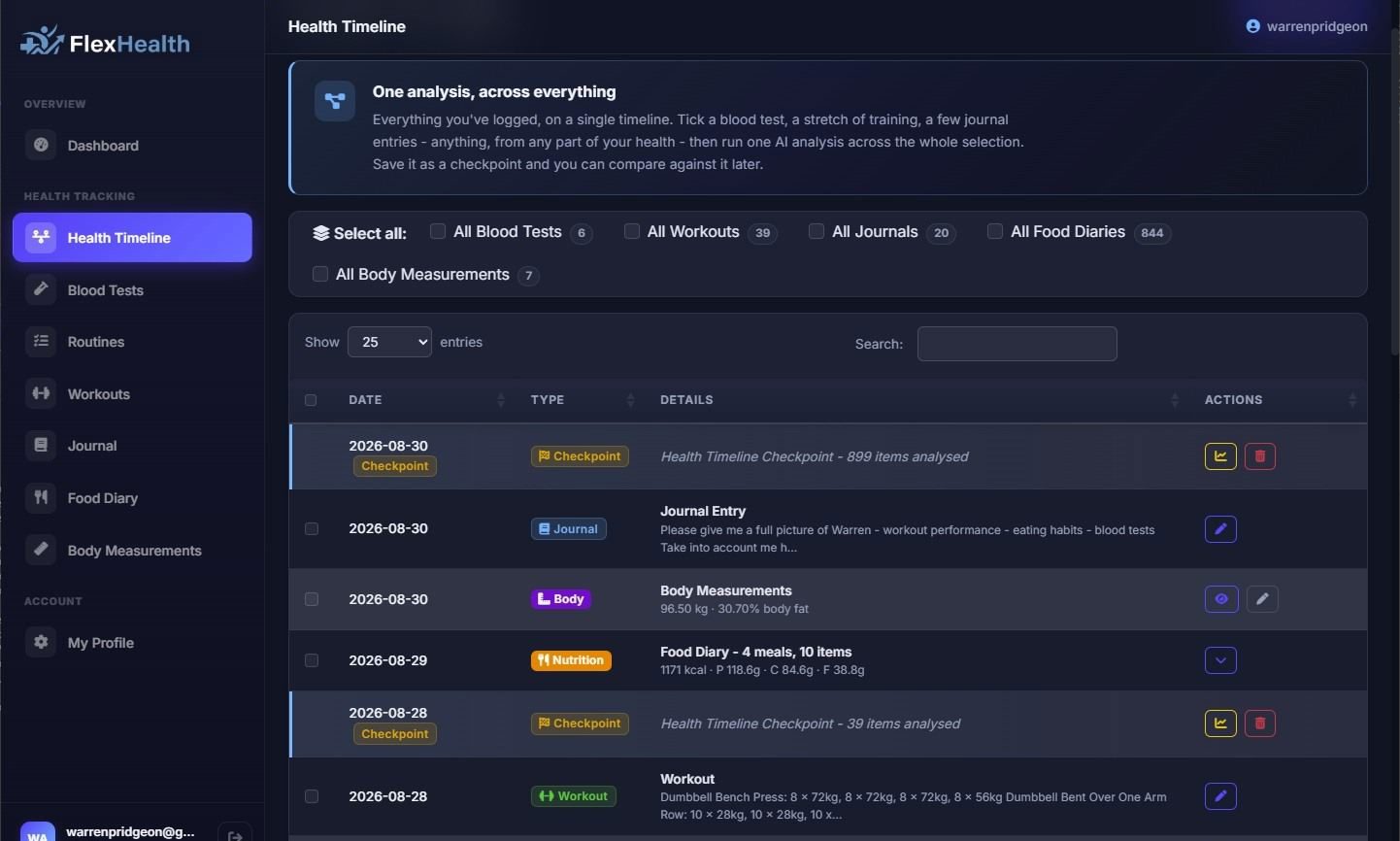
You pick a combination of your logged data (or ALL of it if you want a longterm, broad picture) and ask for one AI analysis across the data selected. You don't get back the "your cholesterol is high... better get it checked", you get "here's what has moved since your last panel" or "you've shown the following trend", if your eating and exercise is part of the analysis that will become part of the story "your liver markers are on a downward trajectory but you went for a blood panel the day after a heavy session which will easily give a false positive, wait 48 to 72 hours after a heavy session before the next bloodwork". The numbers tell you what specifically happened and the journal tells the analysis any other info that might be important (I only ate 600 calories the day before training because I had a root canal and my tooth was sore). The whole shebang gets tied up with a neat bow and becomes a health checkpoint on the Unified Health Timeline.
And if the analysis gets something wrong or is missing some context, you don't just swear under your breath... you correct it and re-run (you can choose to swear AT it if you want. lol). Last night's checkpoint is a real example: I told it to not only look at how often we have fast food but also HOW MUCH. We used to have pizza every Friday, and I would eat like half a pizza and we'd have the rest on Saturday for lunch. Being more disciplined now we're only having pizza every 2nd or 3rd Friday and I only have two pieces... Also with going to gym more I'm getting them sweet sweet Kauai smoothie rewards - which are not QUITE "takeaways".
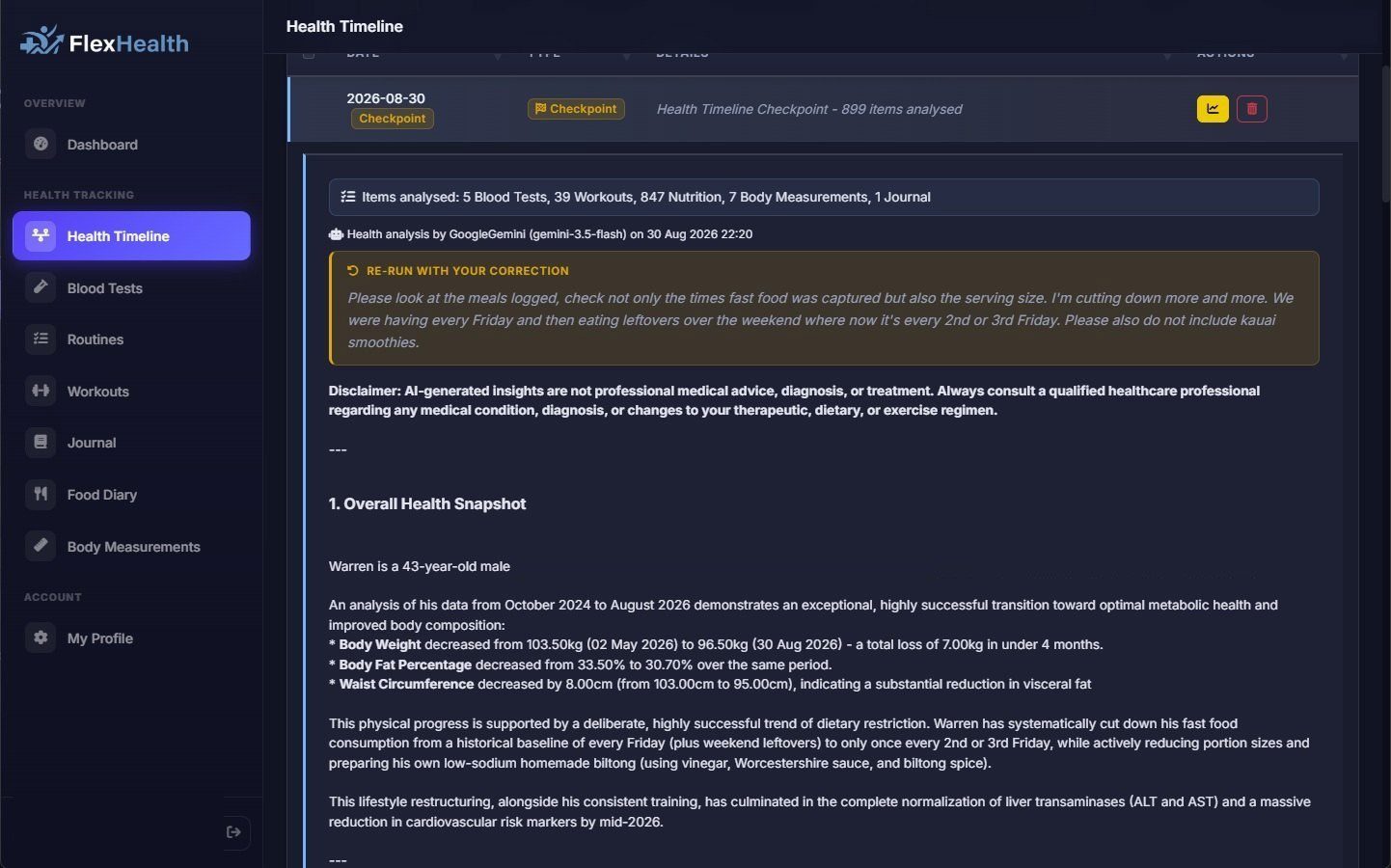
The cross-referencing of knowledge across multiple domains is something I couldn't get in 2024 when I first started repairing the broken windows. And that is what turned my "pages and pages of numbers in a drawer" into useful information which helps guide some of my decisions... this is a repeating pattern in my life and one of the things I do for clients in my business.
Simply put, FlexHealth is a tool that helps me understand my own data. It's NOT a medical device or diagnosis machine... the output is something you can take to your doctor and say "hey here's some thoughts". I've gone to my doctor with printouts and discussion points driven from FlexHealth. I have a doctor that likes people doing their own research to understand what they are dealing with and potential ways to handle things. Find a good doctor, they are worth their weight in tokens.
The AI layer, and who holds your data
This is the part that I've been going back and forth over the most. Health data is very personal data and I don't want to be the guy holding a pile of it for everyone.
The design position: your data, your model, your key. FlexHealth doesn't lock you into a specific AI vendor. You choose the provider and you bring your API key. Nothing gets sent to any AI in the background, your data only goes to the provider YOU chose, when YOU ask for an analysis. If you never click the "analyse" button nothing leaves.
And the ultimate plan, if FlexHealth grows past patient zero (me), is that you shouldn't have to trust me at all. Your data should remain in YOUR hands as much as possible, on your handset and in your own storage, with FlexHealth just being a lens you look at it through. The health-data privacy problem is a lot smaller if the answer to the "where's my data?" question is "on your own drive".
Where FlexHealth sits, honestly
It's a working product and not just a concept deck. It has a web based version and an Android version. Everything mentioned so far has been "shipped to prod" and is in use. It is however still early in its life and I'm being open and honest about that. It was built by me to solve my problems, which means some things are "polished enough" for me to use it myself.
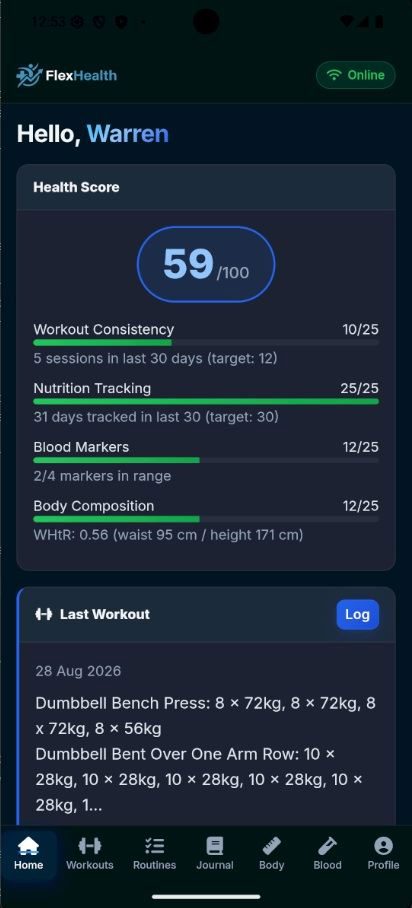
Speaking of honest, here's the Android app this morning. It scores my health 59/100 and tells me straight that I've only trained 5 times in the last 30 days against a target of 12... I had a gout attack in my foot which left me barely able to hobble around the house for almost a week and other "life happening" stuff in August. The app doesn't "care" about my excuses, it's there to show me broken windows, not hide them away.
That is however changing. I'm going to open a small private beta which is free and doesn't need any hardware to buy. It won't be an open "click here to sign up" thing though. If you want in, contact me and we'll chat. That's deliberate: it means you talk to me directly, and the feedback you give genuinely steers what gets built next.
Where it might go
These are potential plans, basically things that could be added in the future... This is not a roadmap that's a guarantee of future stuff coming:
- Take a photo of a printed lab report and have the markers extracted automatically, so that the typing goes away.
- An on-device AI coach/analysis that doesn't need connectivity.
- Voice logging and potentially our 11 official spoken languages (yes... we have 11 spoken, 12 if you count sign language, in South Africa).
The bigger question is whether FlexHealth becomes a product for other people at all, and whether it properly joins the Flex family. At this point the honest answer is... maybe. It's a "just how it is right now" thing. If a tool like this, built how I've described, is something you'd actually use please drop me a line. I want to know if it's only me or if there are other people on a similar journey that this tool would help.
The thing I actually learned
A blood test is a checkpoint in time showing you where you are. Your training, eating and your own words (in journals) tell you the steps you're taking. Putting all of those together starts becoming a roadmap of where you're going.
Logging your data isn't magic and logging your data alone won't change your trajectory... doing something about what the data says does. If you have no idea what the broken windows are you can't start fixing them. The windows in the "back yard" are easier to ignore because you never even see them.
The tool doesn't fix the windows, but the tool finally starts helping you see them.