
I live in a small dorpie about 60km outside Johannesburg. It's pretty rustig except for the Sunday night street races in the main street. There's a rooster two houses over that can't tell the difference between a security light and the sunrise. The problem with the quiet little town is that if you write software for a living the landscape is pretty barren out here.
As a result, I commuted to the greater Johannesburg area for around 10 years.
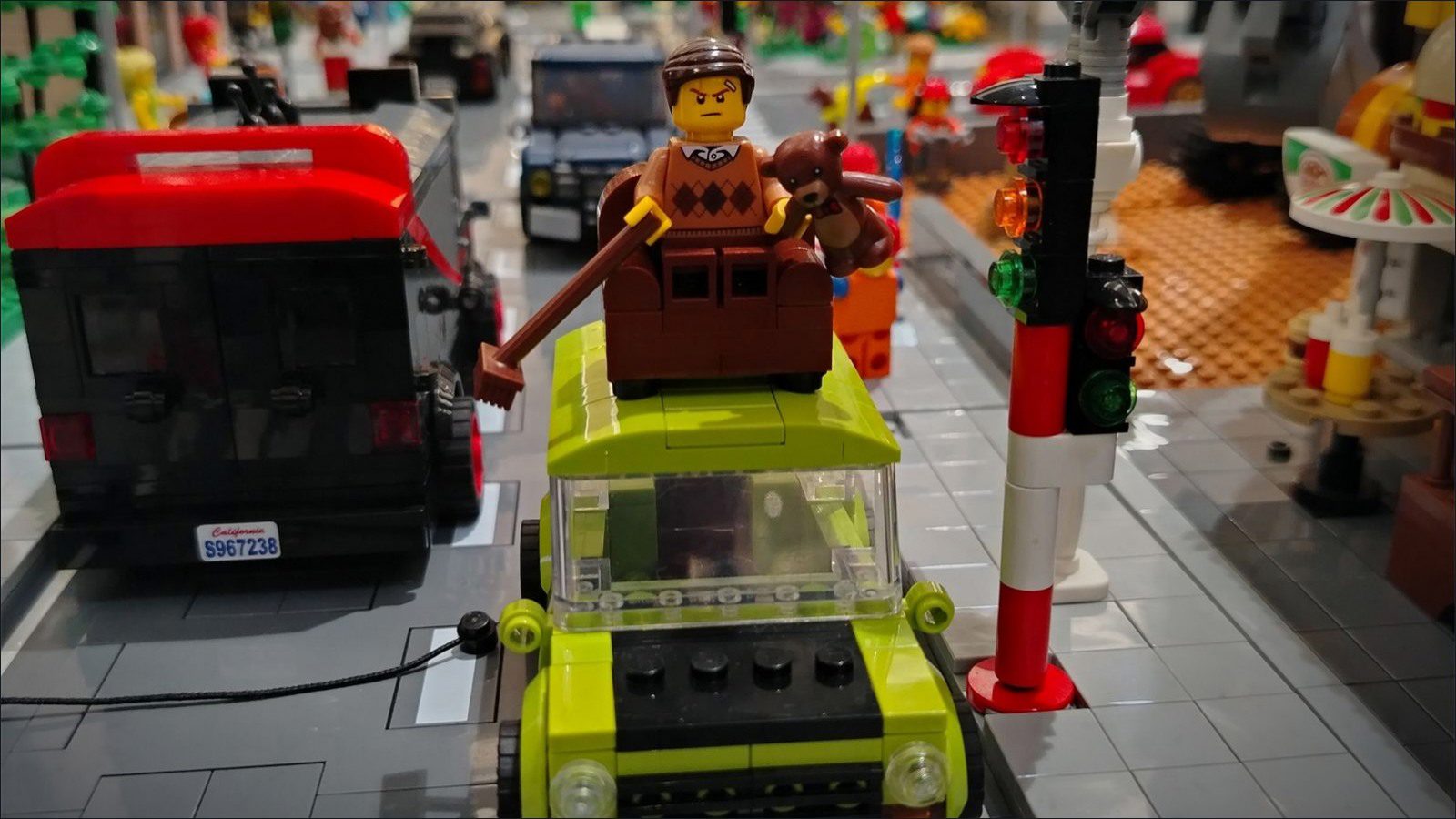
Biting chunks out of the steering wheel.
The maths of getting to work
My first software development gig was in Isando, around 70km from my driveway... And that meant one thing... DUN DUN DUN... Gilooly's interchange. In 2006 a normal morning meant around 50 minutes, but a single accident anywhere CLOSE to the exchange meant easily double that time... and one thing that Gilooly's farms... is accidents. The same run now takes an hour on a GOOD day. On a bad day... I've literally seen people selling cold drinks between the standstill traffic on the highway.
In another life (my last gainful employment, as it turns out) I worked for a company based at the Dimension Data campus in Bryanston. That was about an 80km one way trip right into the Bermuda triangle of Gauteng traffic... where cars, busses and planes disappear.
There was a distinct memory burned into my brain where it took me AN HOUR to get from the campus to the N1. The total distance travelled was a WHOPPING two kilometres. Google Maps reckons it should take a solid 5 minutes.
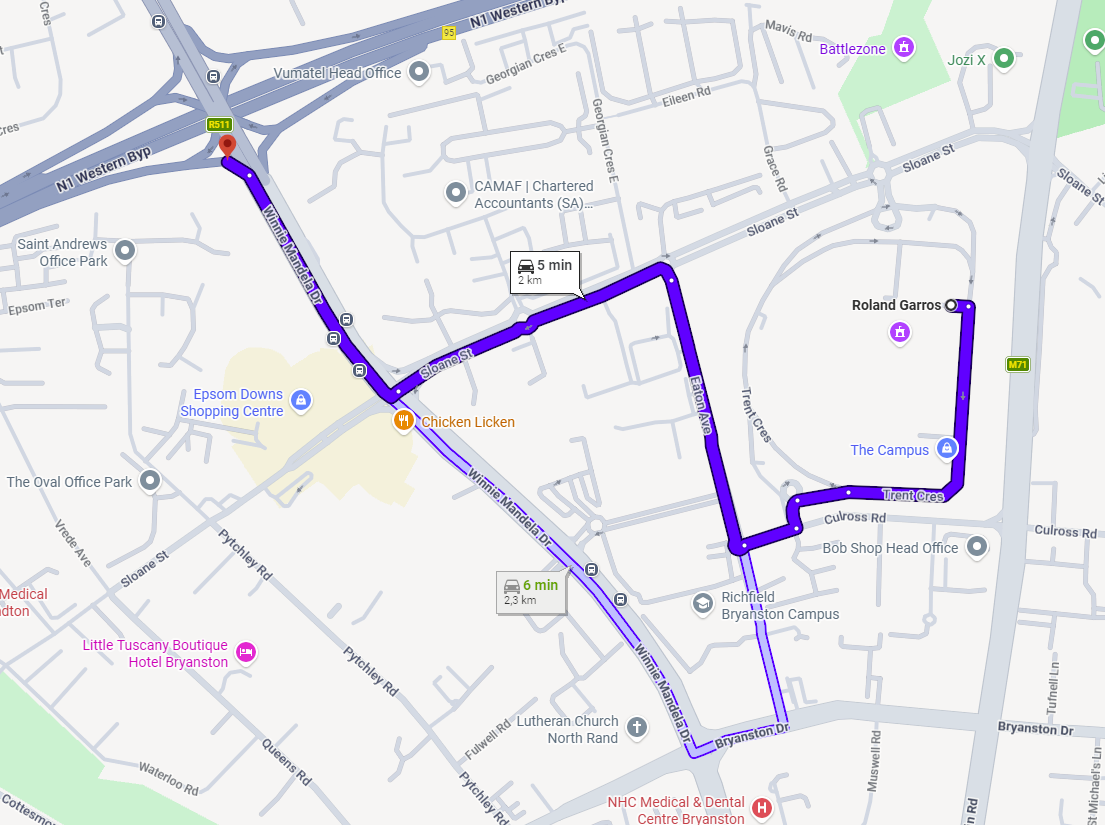
Map: Google Maps. Whatevs Google Maps... whatevs.
I could have walked there and back, stopping at the KFC for an ice-cream. But I found myself idling in traffic, burning dinosaurs and biting chunks out of the steering wheel.
From that day forward, if I came out of the basement parking and saw the road standing still I would head back in and go work for another hour. I'd rather drive my desk for another hour than replace ANOTHER steering wheel.
A solid average was around three hours commuting per day.
Three hours a day, five days a week, forty-six weeks a year is 690 hours. 86 working days. Every year. Spent in a car. My singing voice improved and I had a LOT of time to work on my patience.
That's ONLY the time cost... it doesn't factor in arriving at your desk with fried nerves and needing to attend an anger management course before opening your IDE and mails.
Then: hang a left in the passage
The alternative, for many, is muuuuuch simpler. Hop out of bed, hang a left in the passage, stumble over the cat and straight into the office.
No traffic (except the feline kind). No mandatory decompression stop in the garage before facing the mailbox. Those three hours you normally commute don't disappear into thin air, they get refunded as being able to sleep properly... being able to hit the gym... being able to see your family.
When your job is one that requires sitting at a pc, thinking hard and focusing... this shouldn't be wild or controversial.
Where the wheels come off
Before this comes across as a brochure for "why everyone should work remotely"...
Discipline is what keeps the wheels on the bus going round and round. And without it they fall off faster than a drunk uncle falling off of the deck and into the pool on a fail video. There's a couch that invites napping, or console gaming. You can catch up on Game of Thrones from that couch (I am one of the five people on earth who has never watched it).
The only thing between you and a completely misspent afternoon... is you. Now, if the consequence of not getting your work done is an 80km one way commute to the office, you have extremely good motivation TO GET ISH DONE.
Working from home doesn't make you disciplined... it stops you from hiding whether you are disciplined or not. And if we get down to brass tacks, that's where a lot of resistance comes from.
Thanks, Kwagga
The rest of this is about what the office does TO the work.
(ping) A mail arrives in your mailbox. Before that notification has faded from the corner of your screen... The responsible party arrives at the edge of your desk.
Kwagga: "I've just sent you a mail, when you get a chance please take a look and see what you can do."
At that point it would be semi-ok if they wandered off and left me to my own devices... but noooo... that's too easy. They recite the mail from memory. Verbatim.
Thanks Kwagga, without you arriving at my desk WITH the notification it would have been auto-deleted by the advanced AI mail manager that checks for the arrival of the sender within 10 minutes.
It sounds comical, but context switching during deep thought work takes time. You lose a solid half an hour (if not more) because Kwagga wants to jump the priority queue.
I'm personally an easy target for focus fuzzification. I think I have 80 of them HD's or something. My focus gets easily captured by bright lights, loud sounds and JOKES. If there are shenanigans afoot then I MUST be part of said shenanigans. Those are the rules, I was born with them... I did not write them. An open-plan office is a treacherous landscape for my focus.
If I am in a corner alone, where I can focus... The sparks fly and I light up the keys like the DeLorean hitting the fabled 88mph.
At my last performance review I was told basically "On the technical side we can't ask more from you, you get your stuff done well. But... can you try talk less?".
The receipt
I ran an experiment on this, and it's a story that grates my carrots. Proof doesn't always change the outcome.
I was asked to rewrite a system another department had built, in the same tech stack and to the same standard as our department's other solutions. At the time I was fighting for being allowed to work remotely (which was part of the promise during the interview, but politics ya know).
Manager: "How long?"
Warren: "Roughly three weeks."
Manager: (gives me a look) "And if we let you work from home?"
Warren: "Two."
So gesê so gedaan (rough translation:
so said so done).
I did it in one and a half.
Proudly delivered... to be told "righto, welcome back to the office champ".
The grater still grates. I ran the experiment, under their rules, passed with flying colours... and I was back to three hour commutes.
"If I can see you, you're definitely working"
A lot of companies still run the bums-in-seats model, where they think if they can see the people then the people are working.
Newsflash: people are very good at looking busy. I know people who are ALWAYS busy... busy getting nothing done. They can sit in the direct eyeline of their manager, for years, and get very little done. It's FAR easier to LOOK busy than to pump out software.
If the only way you know whether someone is getting their work done or not is whether you can lay eyes on them or not, you don't have a problem with remote work. You have a management problem.
Honest counter-points
It would be unfair to pretend that this is completely one-sided.
One: you can't get a haircut over the phone. Not yet, anyway. There are MANY jobs that currently require your body in a specific physical location. This whole piece is not directed at a nurse, electrician, panel beater or the dude that climbed up in my roof to replace my burst geyser. Software, by its nature, doesn't require you to be at any specific location to build it.
Two: collaboration. This one is often bandied about as a catchall when someone tries to bring up remote working, and it's real. A buddy was struggling with something for a few hours and eventually was like "Warren can you see what's wrong here?"... I walked over and pointed at a single hash (#). TheControlsID actually read #TheControlsID. Stare at the same stuff for hours and it LOOKS correct.
"Delete the hash"... 30 seconds later I heard "F*** you Warren" out of sheer exhaustion. LOL.
But if I do the math, I didn't see that kind of thing happen often. For most of my career I was left to my own devices, and that was in the office, with developers sitting one desk over, with their headphones going full blast. That's not collaboration, that's proximity.
Hold the phone, haven't you mentioned how seeing the results excites you?!
Yes... and I even have an upcoming post about it. That one argues that developers should be customer facing, seeing the mess and feeling the friction directly. Yet, here I am asking to work from the comfort of my home. The question is fair.
The difference is which room the developer is in and WHY.
Presence with purpose is far better than "because company policy". When you as a developer get in the room with a client you can see how they use the thing you built. You get to experience the highs of "wow this is really helping us", but also the lows of "this doesn't make sense this way". That is worth more than a year of sitting 80km from home with colleagues who are all working on their own projects. It's the same reason I will get in my car and do a two hour trip to Brits to visit clients, because there ARE things that work better in person. Forward deployed means going where the friction is, not where the keycard works.
One of the rooms tells you what to build and why, the other tells you what time you clocked in.
Hybrid
I am NOT completely "anti-office", I am anti-office-as-the-default.
There are some things that just work better in person:
- Kickoffs
- Catchups with clients
- The annual table tennis tournament
- Whiteboards
- When something isn't making sense over text threads
- Demos
- When a new build goes live where "all hands on THIS problem" actually does some good.
Those days are worth the Gilooly's tax, and I pay it GLADLY.
Remote work for the things that "the room" is actively bad at, which for a developer is long uninterrupted time where they can focus and write the code. That work often needs a quiet corner, a monster and four hours of "do not disturb". Open plan offices are simply unable to provide this.
Hybrid is NOT "three office days, two home days" written in a company policy by someone who has never had to deliver code. Hybrid is "in the room when the room helps, out the room when it doesn't".
The actual measure
In my ideal world a developer could work from the deck of a cruise ship. As long as the work is done well and on time.
That should be the measure, NOT how many hours they spent in their office chair, NOT how many times they clocked in at the corporate office this month and NOT whether their manager can physically see them.
Judge developers on what they deliver. If it is overdue or poorly done, get in there and have the tough conversation. If it is ahead of schedule and done well, it doesn't matter where it was done from.
Now that I am self employed I get to set my hours AND working location. I start earlier, maybe go hit the gym midday, and finish later, which the bums-in-seat model would never allow. A couple of times a year I go and work from a sea view. I get up before the fandamily and do a couple of hours of work, then go out for an ice-cream, a swim in the sea or go fishing. Later I'm back at my desk, clickity clacking the keyboard. Clients get their systems delivered, often not knowing I am not at my normal abode.